
Borrowing Power Calculator: how much can I borrow?

The Borrowing Power Calculator estimates how much a lender may let you borrow to buy a property, from your income after tax, your living costs and your debts. Like Australian banks, it tests the loan at 3 percentage points above the loan rate, APRA's minimum buffer, and takes off tax at the ATO's 2026/27 resident rates. For example, a single investor on a $100,000 salary with no debts, borrowing at 6% (tested at 9%), can borrow about $591,000. It is an estimate: each lender applies its own policy.

Rates as at 22 October 2026 for the ATO's 2026/27 tax rates and APRA's buffer and lending limit; the living cost floor and the default rates are the calculator's own settings

$591,000
about what one person on $100,000 a year, with no children or debts, could borrow for an investment at 6%.
3 points
added to the rate when the repayment is tested: at 6% the loan is tested at 9%.

Work out your borrowing power

Buying
Who is borrowing
Children who depend on you
Deposit
State or territory of the property
You could borrow about
$591,000
Repayments tested at 9%: 6% plus a 3 point buffer
Monthly repayment at 6% over 30 years
$3,543
Property price with a 20% deposit
$738,750
Deposit
$147,750
Stamp duty in NSW
+$27,433
Cash the purchase needs
$175,183
  • Living costs: the calculator's living cost floor for your household, $1,700 a month, is used because it is more than the costs entered.
  • An estimate: tax on the ATO's 2026/27 resident rates, rent and other income counted at 80%, credit cards at 3% of the limit a month. Each lender assesses income, costs and limits its own way.

If rates rise

+0.25 points, 6.25%$578,000−$13,000
+0.5 points, 6.5%$565,000−$26,000
+1 point, 7%$542,000−$49,000

Presm's Borrowing Power calculator: after tax income less living costs and debts, tested at the rate plus a buffer over 30 years. An estimate, not a lender's offer or financial advice.

How much can I borrow on my income?

What four households could borrow for an investment at 6%, by total income before tax, with no debts and the calculator's living cost floor. A couple earns half each. Every figure is worked out by the calculator above.

Estimated borrowing power by household income, an investment at 6%, 2026/27 tax rates
Household incomeSingle, no childrenSingle, 2 childrenCouple, no childrenCouple, 2 children
$60,000$310,000$136,000$259,000$85,000
$80,000$450,000$276,000$420,000$246,000
$100,000$591,000$417,000$570,000$396,000
$120,000$732,000$558,000$707,000$533,000
$150,000$932,000$758,000$917,000$743,000
$200,000$1,218,000$1,027,000$1,235,000$1,044,000

Presm's Borrowing Power calculator: ATO 2026/27 resident tax rates with the low income tax offset and the Medicare levy, repayments tested at 9% over 30 years, capped at 8 times income. Estimates only.

What the last RBA decision did to this example

On 30 September 2026 the Reserve Bank raised the cash rate target by 0.25 points, to 4.60%. Lenders set their own rates and decide how much of a move they pass on. If a lender passed the whole rise on to the example here, a single investor earning $100,000 in NSW, the rate would go from 6% to 6.25%, and with the buffer the tested rate rises the same, so the calculator's borrowing would go from $591,000 to $578,000: $13,000 less.

Source: Reserve Bank of Australia, Cash Rate Target, read 22 October 2026. The borrowing: Presm's Borrowing Power calculator, the same sum as the strip above. An estimate, not a lender's offer.

Worked examples

A single investor on $100,000

One borrower, $100,000 salary, no other income or debts, living costs below the floor, 6% rate, 20% deposit, NSW. Tax at the ATO's 2026/27 rates.

Tested at
9%
Living cost floor used
$1,700 a month
Estimated borrowing power
$591,000
Repayment at 6%
$3,543 a month

Source: APRA: System Risk Outlook, May 2026; ATO: tax rates for Australian residents
A couple buying a home in Victoria

Two borrowers on $95,000 and $75,000, one dependant, $4,500 a month living costs, 5.5% rate, 20% deposit. Tax at the ATO's 2026/27 rates.

Tested at
8.5%
Estimated borrowing power
$873,000
Property price with a 20% deposit
$1,091,250
Repayment at 5.5%
$4,957 a month

Source: APRA: System Risk Outlook, May 2026; ATO: tax rates for Australian residents

The same investor with $10,000 of card limits

As the first example, plus credit cards with $10,000 of limits in total, unused.

Counted for the cards
$300 a month
Borrowing power without the cards
$591,000
Borrowing power with the cards
$553,000

Source: APRA: System Risk Outlook, May 2026

How the estimate is worked out

First the income after tax: each borrower's salary on the ATO's 2026/27 resident rates, less the low income tax offset, plus the Medicare levy; rent and other income count at 80%. Then the costs each month: your living costs or the calculator's living cost floor for your household, whichever is more, credit cards at 3% of the limit, other loan repayments, and any home loan you already pay, tested at the higher rate. What is left pays the new loan: the calculator finds the loan whose repayment over 30 years, at the rate plus 3 points, equals it, caps it at 8 times your income and rounds it down to the nearest $1,000. A purchase assumes a deposit of at least 20%; stamp duty comes from the Stamp Duty Calculator.

The calculator's living cost floor a month, by household and income
HouseholdIncome up to $150,000Income over $150,000
Single$1,700$1,870
Single, 1 child$2,400$2,640
Single, 2 children$3,100$3,410
Couple$2,700$2,970
Couple, 1 child$3,400$3,740
Couple, 2 children$4,100$4,510

The calculator's own living cost floor a month, used when the living costs entered are lower. It is not the Household Expenditure Measure that lenders use; each lender applies its own.

One number is a start. Presm shows the whole picture.

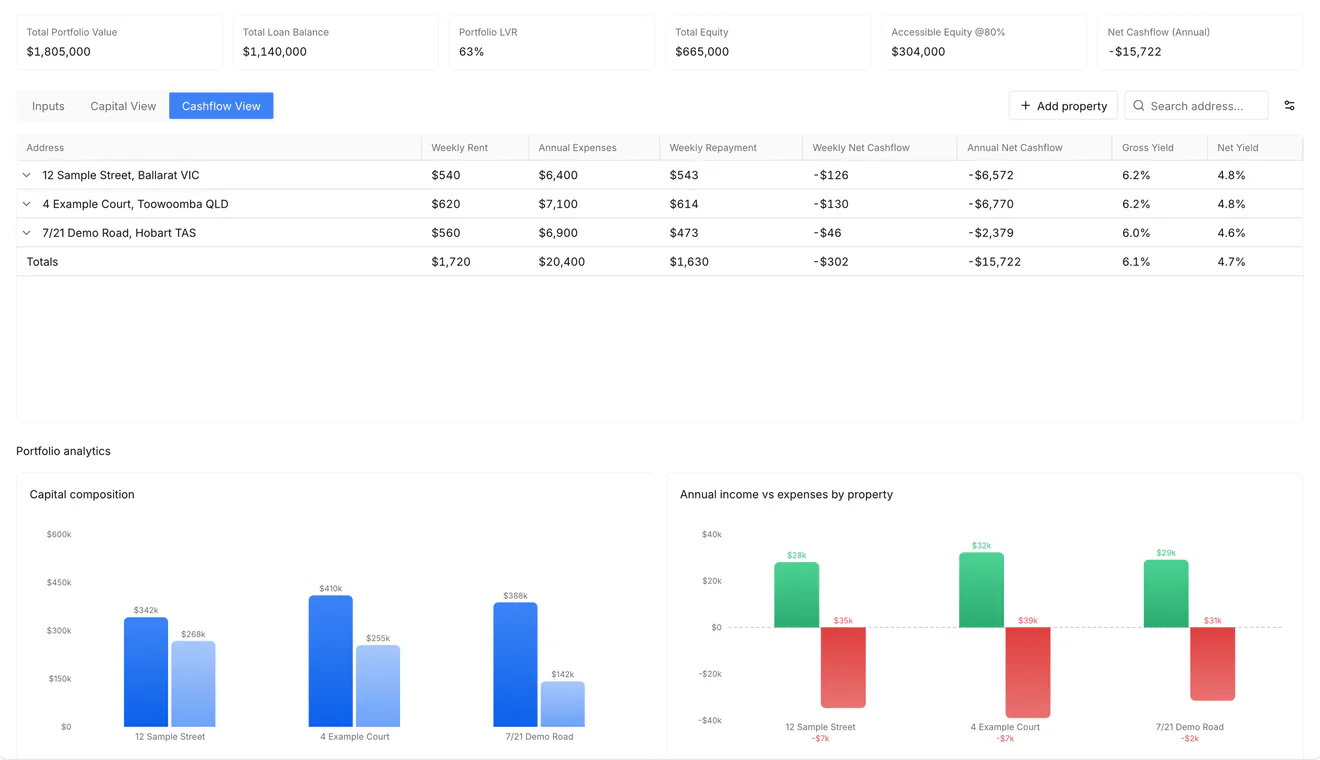
Borrowing power is where a purchase starts. Presm keeps the whole portfolio in view: value, loans, LVR, equity and cash flow for every property, and what the next one would change.

  • Portfolio. Value, loans, LVR, equity and cash flow for every property you own, in one table.
  • Holding costs. What each property costs you weekly, monthly or yearly, every cost on one card.
  • The Plan. Add the next property and see what changes, 10, 20 or 30 years ahead.
  • Calculators. Stamp duty, land tax, borrowing power, LMI and more, in one account.
Get startedNo credit card required to get started.

Want a strategist? Book a discovery call with Rising Returns

Presm Portfolio, Cashflow View: weekly rent, annual expenses, repayments, net cash flow and yields for three fictional properties
Real Presm screen. Illustrative scenario · fictional data · not financial advice

Questions people ask

Short answers, each checked against the rules and the calculator.

How does the calculator work out my borrowing power?

It takes your income after tax, takes off your living costs, card limits and other repayments, and works out the 30 year loan that what is left could repay at the tested rate: your loan rate plus 3 percentage points. Two borrowers are taxed separately, each on their own income. The result is capped at 8 times your assessable income, the calculator's own limit.

What is the serviceability buffer?

It is the margin a bank adds to the loan rate when it tests whether you can repay. Since 2021 APRA has set it at 3 percentage points above the loan interest rate, the minimum every APRA regulated bank must apply, and on 28 May 2026 APRA kept it at 3 points. On a 6% loan you are tested at 9%.

Is there a limit of six times my income?

Not on each borrower. From 1 February 2026 APRA limits each bank to 20% of its new owner occupied lending, and separately 20% of its new investment lending, at a debt of six times income or more; bridging loans for owner occupiers and loans to buy or build new homes are left out. APRA kept the limit unchanged on 28 May 2026. A loan above six times income is still possible, but banks have less room for it. The calculator's own cap is 8 times your assessable income.

What tax does it take off my income?

Each borrower's tax at the ATO's 2026/27 resident rates (nil to $18,200, then 15%, 30%, 37% and 45%), less the low income tax offset (up to $700, ending at $66,667), plus the 2% Medicare levy. On a $100,000 salary that is $20,520 of tax and $2,000 of Medicare levy.

What living costs and debts does it count?

Your living costs, or the calculator's own living cost floor if that is higher: $1,700 a month for one person and $2,700 for a couple, plus $700 for each dependant, and 10% more when income is above $150,000. It is the calculator's setting, not a published benchmark. It counts 3% of your total card limits each month, used or not, and your other loan repayments as you enter them. An existing home loan's repayment is counted at the tested rate, your rate plus 3 points.

Will a bank lend me this much?

Not necessarily. This is an estimate on the calculator's settings (it also counts 80% of rent and other income), while each lender applies its own policy on top of APRA's minimums. APRA lets banks make exceptions to their policies when they are managed prudently and limited; in June 2023 it said exceptions had been 2 to 3% of banks' housing lending. Ask a lender or broker for an assessment.

How much room should I leave for rate rises?

Moneysmart suggests working out what your costs would be if interest rates went up by 3%. The calculator already sets the loan so that its repayment at the tested rate fits within what is left of your income each month: for the single investor above that is $4,757 a month, against a repayment of $3,543 at 6%.

Read more on the Presm blog

Sources

Estimates only, not financial, tax or legal advice. Ask your lender or broker what they would lend before you buy.

Your next property,
in perspective.

No credit card required.