What the 2026 tax changes mean for property investors
Among its tax measures, the 12 May 2026 Federal Budget announced three changes that affect property investors: to capital gains tax, to negative gearing and to discretionary trusts. Two are now law: the capital gains tax and negative gearing changes, in the Treasury Laws Amendment (Tax Reform No. 1) Act 2026 and the Income Tax Rates Amendment (Tax Reform No. 1) Act 2026. The ATO's page on the negative gearing and capital gains tax changes, last updated 29 June 2026, says "These measures are now law". Both changes apply from 1 July 2027. The third, a minimum tax on discretionary trusts, is in two bills before Parliament.
Capital gains tax: indexation and a 30% minimum tax
Under the current rules, which still apply to gains made before 1 July 2027, a resident individual, trust or partnership that has owned an asset for at least 12 months can generally reduce the capital gain by 50%. For gains accruing on or after 1 July 2027, that discount is replaced by cost base indexation, which adjusts the purchase price for inflation, and Australian resident individuals pay a minimum 30% tax on certain net capital gains, unless they receive an income support payment such as the Age Pension in that income year.
If you own a home that counts as a new residential dwelling under the new law, you can choose either the 50% discount or the new method when you sell it on or after 1 July 2027.
The Lens works out each gain under today's rules and the new ones. For a property held by you or a trust, bought before 1 July 2027 and sold on or after that date, it splits the gain at 1 July 2027. For the value on that date it uses its own estimate, a value you entered grown at your growth rate, where the law uses the market value just before 1 July 2027 or an apportionment method the Government is still developing.
Negative gearing: new builds and earlier purchases keep it
From 1 July 2027, an established home bought under a contract entered into from 7:30 pm AEST on 12 May 2026 can offset its losses only against income from residential property, including capital gains on residential property; losses beyond that are carried forward. A home you bought, or entered into a contract to buy, before then keeps negative gearing while you own it, and so does an eligible new build.
In the Lens, an established investment property owned by you or a trust and bought from 7:30 pm AEST on 12 May 2026 to 30 June 2027 offsets its losses normally in 2026 to 27 and is limited from 2027 to 28.
Trusts: a minimum tax still before Parliament
The Budget also announced a 30% minimum tax on discretionary trusts from 1 July 2028. It is in the Treasury Laws Amendment (Tax Reform No. 3) Bill 2026 and the Income Tax Rates Amendment (Minimum Tax on Discretionary Trusts) Bill 2026, both introduced on 14 October 2026 and still before Parliament, so it is not law.
The Lens includes it in part: for an asset held in a trust and sold after the trust tax starts, it taxes the capital gain at no less than 30%. It does not apply the minimum tax to a trust's yearly rental income, and does not model the credits beneficiaries receive.
Ownership structure can also change land tax in most states: the Entity Land Tax Simulator compares the yearly land tax on the same land held by an individual, a company or a trust, in every state and territory.
How the Tax Reform Lens works
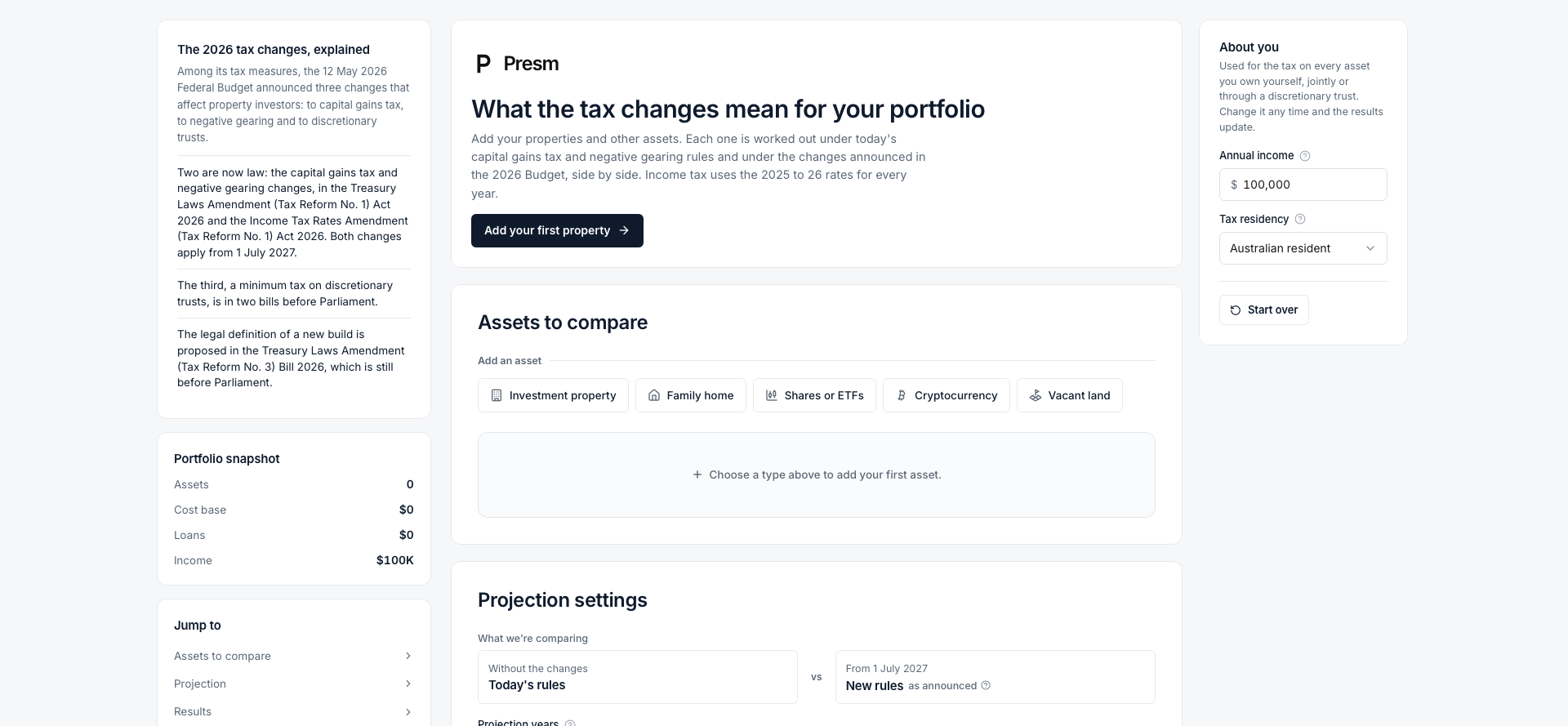
Add your properties and other assets, and the Lens works out each one under today's rules and the new ones, side by side, year by year. It runs without signing up. It models today's rules and the changes as the 12 May 2026 Budget announced them, and it is not tax advice.
Frequently asked questions
What do the 2026 tax changes mean for property investors?
Among the tax changes in the 12 May 2026 Budget are three that affect property investors. Two are now law and apply from 1 July 2027: for gains accruing on or after that date, the 50% capital gains discount is replaced by cost base indexation and a 30% minimum tax on real gains; and an established residential property bought from 7:30 pm AEST on 12 May 2026 can offset its losses only against income from residential property, including capital gains. The third, a 30% minimum tax on discretionary trusts from 1 July 2028, is in two bills before Parliament.
Are the changes law?
Yes for the capital gains tax and negative gearing changes: they are in the Treasury Laws Amendment (Tax Reform No. 1) Act 2026 and the Income Tax Rates Amendment (Tax Reform No. 1) Act 2026, both given Royal Assent on 26 June 2026. The ATO's page on them, last updated 29 June 2026, says "These measures are now law". The trust minimum tax is not law: it is in the Treasury Laws Amendment (Tax Reform No. 3) Bill 2026 and the Income Tax Rates Amendment (Minimum Tax on Discretionary Trusts) Bill 2026, both before Parliament. The first of those bills also holds further capital gains tax and negative gearing rules, including the definition of a new residential dwelling.
When do the changes start?
Both changes apply from 1 July 2027: the new capital gains method applies to gains accruing on or after that date, and the limit on negative gearing applies from that date too. The trust minimum tax was announced to start on 1 July 2028.
Does it change property I already own?
For negative gearing, not if you bought it, or entered into the contract to buy it, before 7:30 pm AEST on 12 May 2026, or if it counts as a new build for you under the law. For capital gains, the old rules, including the 50% discount, still apply to gains made before 1 July 2027, and the new method applies to gains accruing on or after that date; a new build can keep the 50% discount instead.
Can I still negatively gear a new build?
Yes, if the home counts as a new build for you. You keep negative gearing on it, and when you sell you may choose either the 50% capital gains discount or cost base indexation and the 30% minimum tax. The legal definition of a new build is proposed in the Treasury Laws Amendment (Tax Reform No. 3) Bill 2026, which is still before Parliament.
How does indexation compare with the 50% discount?
Indexation adjusts the cost base for inflation, using the consumer price index, before the gain is worked out. If you are an Australian resident individual, a minimum tax rate of 30% then applies to certain net capital gains, unless you receive certain payments, such as the Age Pension or JobSeeker, in the financial year you make the gain. Which costs less depends on your returns, inflation over the years held and your marginal tax rate. The Lens works out both for your own figures, using the inflation rate you set, and it does not apply that payment exception.
What about family trusts?
If your family trust is a discretionary trust, it may be caught: the Budget announced a 30% minimum tax on discretionary trusts from 1 July 2028, with some trusts and some income excluded. It is in two bills introduced on 14 October 2026 and still before Parliament, so it is not law.
Where can I read the official text?
The ATO's page on the negative gearing and capital gains tax reform sets out the changes now in law; the Budget papers are at budget.gov.au; the two bills for the trust minimum tax are on the Parliament of Australia's website. Check current ATO guidance before a binding decision.
Is Tax Reform Lens advice?
No. It is a model of the tax rules before and after the changes announced in the 12 May 2026 Budget, using the figures you enter, and it does not consider your whole situation. For decisions on real money, work with a registered tax agent and a licensed financial adviser.