
Rentvesting Calculator: rent where you live and invest, or buy a home?

The Rentvesting Calculator compares two paths: buying a home to live in, or renting where you live and buying an investment property. For each it shows the equity you build and the money you pay out, year by year, on the prices, rents, rates and growth you enter. The paths differ in more than rent: in NSW an $800,000 first home to live in pays $0 in stamp duty, the same property as an investment $30,187. The 2026 tax reform is law and applies from 1 July 2027, and the calculator does not yet apply it; for an established investment bought from 7:30 pm AEST on 12 May 2026 use Tax Reform Lens.

Figures as at 22 October 2026 for the tax law, stamp duty and land tax quoted here; the calculator still applies the tax rules from before the 2026 reform, and the prices, rents, rates and growth are the figures you enter

−$136,867
rentvesting against buying a home after 10 years, on the starting assumptions below, with a new build as the investment.
2 paths
one deposit of $142,000: a home to live in, or rent and an investment.

Compare the two paths

Your tax rate
Compare after
Rentvesting against buying a home, after 10 years
−$136,867
Equity less the money paid out along the way, on your assumptions
Buying: equity in the home
$579,868
Buying: paid out (repayments and costs)
$476,006
Rentvesting: equity in the investment
$573,309
Rentvesting: paid out (rent, repayments and costs, less rent in and tax)
$606,314
Buying: equity less paid out
+$103,862
Rentvesting: equity less paid out
−$33,005
  • Both paths start with the same $142,000 deposit and grow at the same 4% a year unless you change it. Growth is an assumption, not a forecast.
  • Rentvesting pays $770 a week in rent and earns $600 a week from the investment, both rising 3% a year; a loss on the investment cuts tax at your 30% rate.
  • Purchase costs such as stamp duty are left out; they differ by state and buyer.

The tax figures use the rules before the 2026 tax reform, which still fit a new build. The reform is now law: from 1 July 2027, a rental loss on an established home bought under a contract entered into from 7:30 pm AEST on 12 May 2026 only reduces tax on income from residential property (the rest carries forward), and for gains accruing on or after 1 July 2027 Australian resident individuals get indexation and a 30% minimum tax instead of the 50% discount. For an established home bought now, use the Tax Reform Lens

Presm's Rentvesting calculator: both paths year by year on the same engine as the app, principal and interest over 30 years, on the assumptions above and in the table below. Not financial or tax advice.
Both paths, year by year

On the starting assumptions: the equity each path holds, and equity less the money paid out along the way. Every figure is worked out by the calculator above.

Buying a home against rentvesting, year by year, on the starting assumptions
YearBuying: equityBuying: equity less paid outRentvesting: equityRentvesting: equity less paid outRentvesting less buying
Year 1$177,860+$131,460$177,185+$121,019−$10,441
Year 3$254,330+$114,388$252,299+$81,063−$33,325
Year 5$337,611+$103,086$334,231+$44,060−$59,026
Year 10$579,868+$103,862$573,309−$33,005−$136,867
Year 20$1,253,588+$268,405$1,243,671−$94,326−$362,731
Year 30$2,301,797+$756,142$2,301,641+$44,861−$711,281

Presm's Rentvesting calculator on the assumptions below. Estimates only.

Worked examples

$800,000 in NSW: a first home or an investment

NSW, $800,000 property, a first home buyer who lives in it, compared with buying it as an investment.

Stamp duty, first home to live in
$0
Stamp duty, as an investment
$30,187

Source: Revenue NSW: First Home Buyers Assistance Scheme; Revenue NSW: current thresholds and rates

Land tax on $700,000 of Queensland land

Queensland, $700,000 land value, owned by an individual, as an investment compared with as your home.

As an investment, a year
$1,500
As your home
$0

Source: Queensland Revenue Office: land tax for individuals

How the comparison is worked out

Each year, for each path: the property's value grows at the growth rate, the loan is paid down, and equity is the value less the loan. Buying pays the repayments and the running costs. Rentvesting pays its rent, the investment's repayments and costs and the property manager, takes in the rent the investment earns, and, when the investment makes a loss for tax, pays less tax at your rate. The comparison is equity less everything paid out, path against path.

The starting assumptions
AssumptionStarting value
Home and investment price$710,000 each (change either above)
Deposit$142,000 for either path
Loanprincipal and interest over 30 years, at 5.5% for a home and 6% for an investment (the calculator's own rates)
Growth in value4% a year for both (an assumption, not a forecast)
Rent paid and earned$770 and $600 a week, both rising 3% a year
Running costs, each propertyinsurance $1,500, council rates $2,200, water $1,000, repairs $3,000 a year, rising 3% a year
The investment only2% of the year empty, 7% of the rent to a property manager; a loss cuts tax at your rate (2026/27 rates)
Left outstamp duty and other purchase costs, strata, depreciation, land tax and selling costs

One number is a start. Presm shows the whole picture.

A comparison is one decision. Presm keeps the whole portfolio in view once you buy: value, loans, equity and cash flow for every property, and what the next one would change.

  • Portfolio. Value, loans, LVR, equity and cash flow for every property you own, in one table.
  • Holding costs. What each property costs you weekly, monthly or yearly, every cost on one card.
  • The Plan. Add the next property and see what changes, 10, 20 or 30 years ahead.
  • Calculators. Stamp duty, land tax, borrowing power, LMI and more, in one account.
Get startedNo credit card required to get started.

Want a strategist? Book a discovery call with Rising Returns

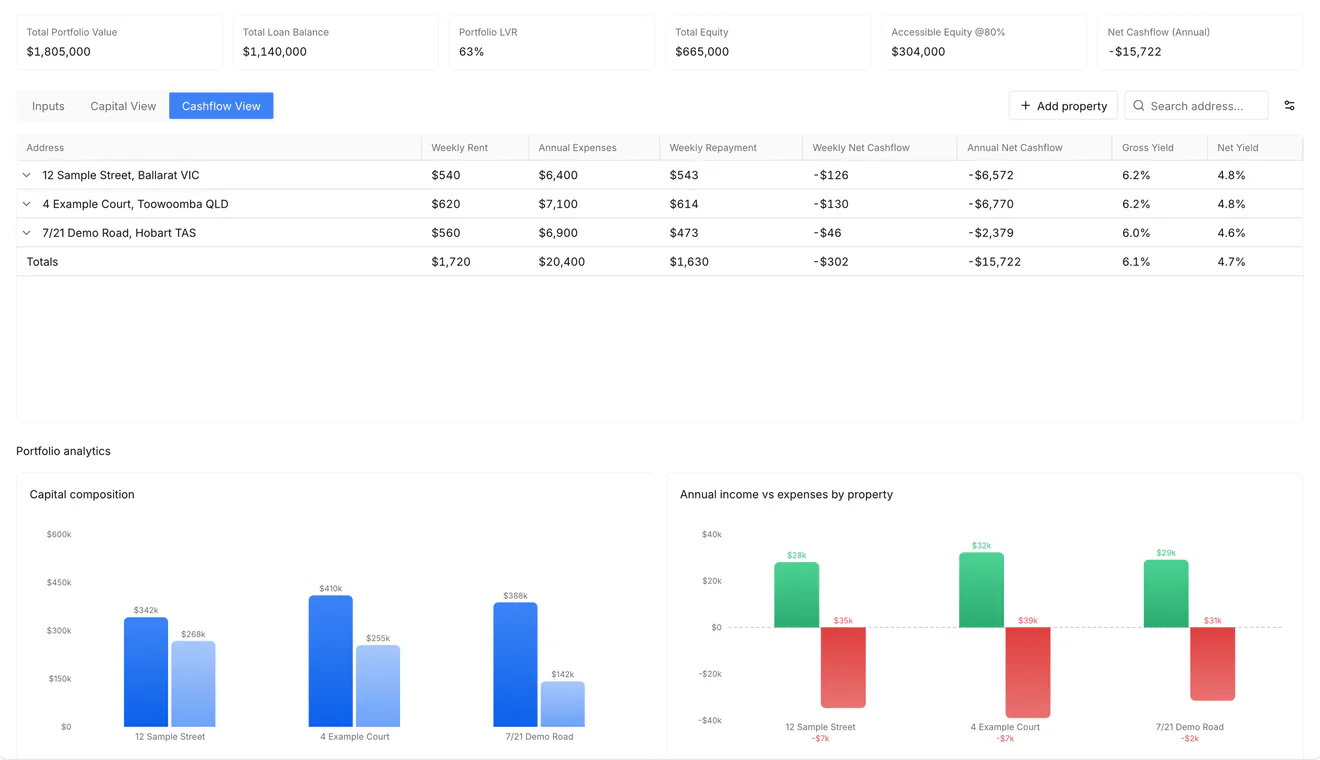
Presm Portfolio, Cashflow View: weekly rent, annual expenses, repayments, net cash flow and yields for three fictional properties
Real Presm screen. Illustrative scenario · fictional data · not financial advice

Questions people ask

Short answers, each checked against the rules and the calculator.

What is rentvesting?

Renting the home you live in while you buy an investment property, often somewhere more affordable. The two paths are taxed differently: the home you live in is generally exempt from capital gains tax, while an investment property is not, and its rent is taxable income.

How does the 2026 tax reform affect rentvesting?

It is law and applies from 1 July 2027. Losses on an established property bought under a contract entered into from 7:30 pm AEST on 12 May 2026 can only be deducted against income from residential property, including capital gains, and the rest carries forward; they cannot reduce tax on wages. A property bought, or contracted, before that time keeps negative gearing, and so does an eligible new build. For gains accruing on or after 1 July 2027, Australian resident individuals lose the 50% CGT discount and get cost base indexation and a 30% minimum tax instead; a new build can keep the 50% discount. This calculator still applies the old rules, so for an established property bought from 7:30 pm AEST on 12 May 2026 use Tax Reform Lens.

Do I lose first home buyer stamp duty savings by rentvesting?

Usually, because the concessions are for a home you live in. In NSW a first home buyer pays no transfer duty on a home to live in up to $800,000 under the First Home Buyers Assistance Scheme: $0 on an $800,000 home. Bought as an investment, the same property costs $30,187.

Does an investment property pay land tax?

It can. The home you live in is generally exempt, but an investment property counts towards land tax once your land in that state passes the threshold. In Queensland an individual pays from $600,000 of land value: $700,000 of land costs $1,500 a year as an investment, and $0 as your home.

What does the calculator count?

For each path it adds up the equity you build (the property's value less the loan, so your deposit is in it) and the money you pay out each year: repayments, rent and costs, less any rent you receive, after tax at the ATO's 2026/27 resident rates. The deposit is not counted again in the money paid out; both paths put in the same deposit. It shows both paths year by year and the difference between them, as figures, not a verdict. Growth, rents and rates are the figures you enter.

Will I pay lenders mortgage insurance?

On either path, usually yes if you borrow more than 80% of the property's value, that is with a deposit under 20%. The insurance protects the lender, not you. Rentvesting in a cheaper area can make a 20% deposit easier to reach.

Read more on the Presm blog

Sources

Estimates on assumptions you can change, not financial or tax advice. Speak with a licensed adviser before you decide.

Your next property,
in perspective.

No credit card required.