
Wealth Accelerator: plan the purchases that build a property portfolio by your target age

The Wealth Accelerator plans the purchases that could take you to a target number of investment properties by a target age, from your savings and monthly surplus and the growth, rent and interest rate you choose, and checks when the debt would pass 7 times your income. It shows each purchase, then the portfolio's value, loans and cash flow before tax year by year. In the page's example, someone aged 35 on $150,000 with $150,000 to invest and $2,000 a month to spare can fund 2 of 2 properties, but the debt passes 7 times their income in 2039, at age 48, so the engine rules the plan not achievable as entered. At 55 the properties are worth $3,449,287 with $1,404,252 still owed, and fall $45,874 a year short before tax. The figures follow your settings; they are not a forecast.

Figures as at 22 October 2026 for the tax law and the rules quoted here; growth, rent, interest and yield are the figures you enter, and cash flow is before tax

$2,045,035
equity at 55 in the example, from $150,000 and $2,000 a month over 20 years.
2 of 2
properties the example can fund from savings and then equity; the debt passes 7 times income in 2039, at age 48, so the engine's verdict is: not achievable as entered: the debt against income is the limit.

Project your portfolio

An example to change, not a forecast.

Properties to own by the target age
Equity at 55
$2,045,035
The portfolio's value less its loans, in the engine's own projection
The engine's verdict
Not achievable as entered: the debt against income is the limit
Debt passes 7 times income
in 2039, at age 48
Properties funded
2 of 2
Portfolio value at 55
$3,449,287
Loans at 55
$1,404,252
Cash flow a year at 55, before tax
−$45,874
Properties pay for themselves from
not by 55
Deepest yearly shortfall
−$50,220 in 2044 (about $4,185 a month)
  • 2032 $871,062deposit and costs $251,152: $251,152 from savings, $0 from equity
  • 2039 $1,225,672deposit and costs $355,762: $210,848 from savings, $144,914 from equity

Presm's Wealth Accelerator on the app's own engine, before tax, starting with no properties owned. A projection of the assumptions entered, not financial advice.

What the target changes

The same example (35 to 55, $150,000 to invest, $2,000 spare a month, 5% growth, 4% rent yield, 6% interest) with a target of 2 to 6 properties. More properties grow the equity, and deepen the years the portfolio costs money. Every figure is worked out by the engine above.

The example with a target of 2 to 6 properties, the engine's figures
TargetProperties fundedDebt passes 7 times incomeEquity at 55Cash flow a year at 55Deepest yearly shortfallPays for itself from
2 properties22039$2,045,035−$45,874−$50,220not yet
3 properties32036$2,971,263−$73,104−$73,104not yet
4 properties42034$3,963,307−$79,939−$92,931not yet
5 properties42036$3,841,560−$85,289−$94,167not yet
6 properties42037$3,589,427−$95,914−$100,525not yet

Presm's Wealth Accelerator, the example above, no properties owned at the start, before tax. A projection of these assumptions, not a forecast and not financial advice.

Worked examples

The page's example: a target of two properties by 55

Age 35 to 55, $150,000 income, $150,000 to invest, $2,000 a month to spare, a target of 2, 5% price growth, 3% rent growth, 6% interest, 4% yield, 5 years interest only, no property owned.

Properties funded
2 of 2
Debt passes 7 times income
2039, at age 48
The engine's verdict
not achievable as entered
Portfolio value at 55
$3,449,287
Loans at 55
$1,404,252
Cash flow a year at 55, before tax
minus $45,874
Deepest yearly shortfall
minus $50,220

Source: Moneysmart (ASIC): interest only home loans

The same plan at 8% interest

As the first example, with 8% interest instead of 6%.

Properties funded
2 of 2
Cash flow a year at 55, before tax
minus $69,937
Deepest yearly shortfall
minus $74,283

Source: Moneysmart (ASIC): choosing a home loan

How the projection works

The engine spreads the purchases evenly over the years to your target age. Each is priced at $650,000 today, the engine's starting price when you own nothing yet (with properties owned, it uses their average), grown at the growth rate to the year of purchase. Each needs a 25% deposit plus the NSW investor stamp duty on the price.

The deposit and costs come from savings first (the money to invest now plus what you put aside each month), then from equity: up to 80% of the portfolio's value less its loans. A purchase that cannot be funded is skipped. Each loan is 75% of the price, interest only for the years set, then principal and interest over the rest of 30 years.

Rent is the yield on the price, growing each year with rent growth, less 3% for vacancy; running costs are 30% of the rent and grow the same way. Cash flow is rent less costs less loan payments, before tax. Values grow at the growth rate and equity is the portfolio's value less its loans.

Each year the engine also sets the loans against your income and marks the year the debt passes 7 times income, the limit it takes for lenders; that is the only use it makes of your income. Its verdict weighs that limit with the cash flow, the savings and equity, and the time to your target age.
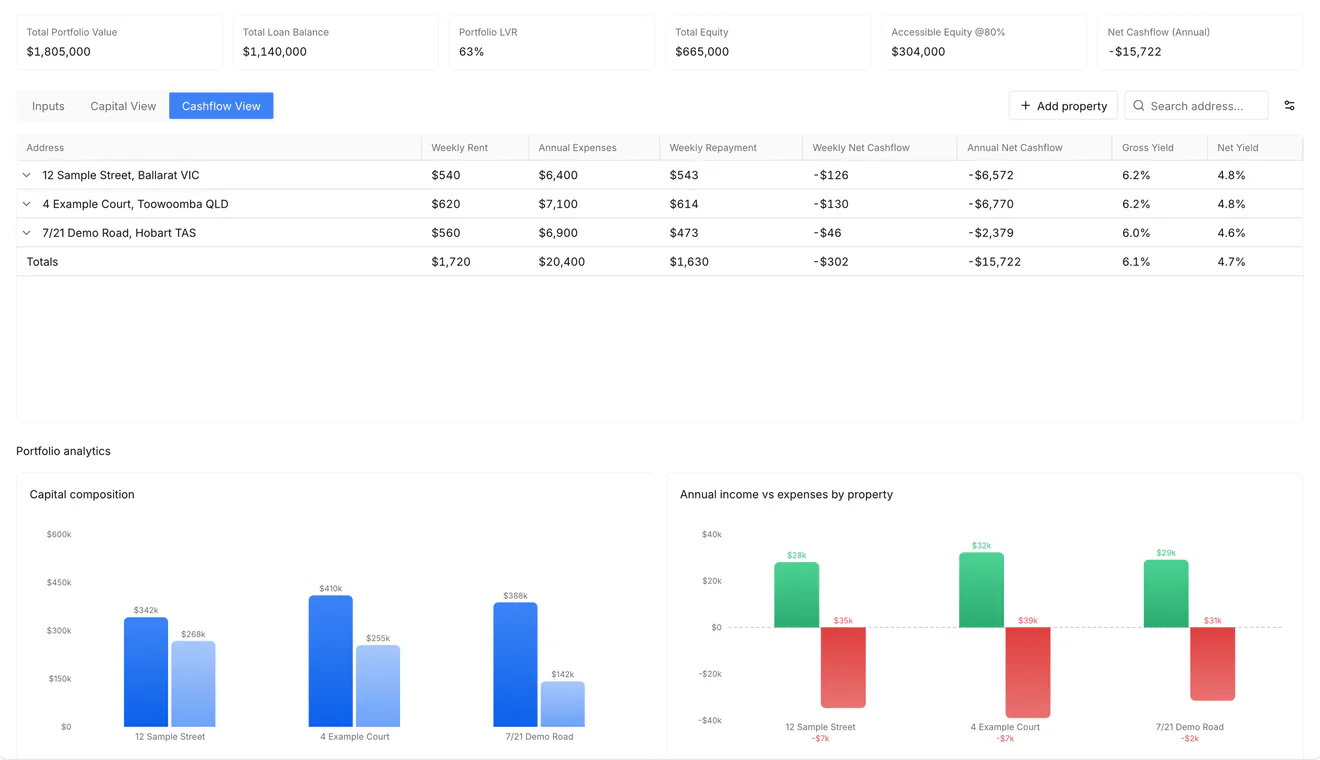
One number is a start. Presm shows the whole picture.

A projection is a start. In Presm the properties you own sit in one table, with their value, loans and cash flow, and The Plan shows what the next purchase would change.

  • Portfolio. Value, loans, LVR, equity and cash flow for every property you own, in one table.
  • Holding costs. What each property costs you weekly, monthly or yearly, every cost on one card.
  • The Plan. Add the next property and see what changes, 10, 20 or 30 years ahead.
  • Calculators. Stamp duty, land tax, borrowing power, LMI and more, in one account.
Get startedNo credit card required to get started.

Want a strategist? Book a discovery call with Rising Returns

Presm Portfolio, Cashflow View: weekly rent, annual expenses, repayments, net cash flow and yields for three fictional properties
Real Presm screen. Illustrative scenario · fictional data · not financial advice

Questions people ask

Short answers, each checked against the rules and the calculator.

What does the Wealth Accelerator do?

It plans when you could buy each investment property on the way to your target, using your savings, your monthly surplus and the equity the properties build, then projects their value, loans, equity and cash flow each year to your target age. Property can earn rent and grow in value over time; the calculator shows what your own settings for both lead to.

What does cash flow before tax mean?

Rent received less interest, repayments and costs, each year, before any income tax. In the example the properties fall $45,874 a year short at 55, and the deepest yearly shortfall is $50,220, more than the $24,000 a year the $2,000 monthly surplus provides. Tax is not counted, and from 1 July 2027 losses on an established property bought under a contract entered into from 7:30 pm AEST on 12 May 2026 can only be deducted against income from residential property, not wages; that law is now in force. Tax Reform Lens shows an investment under it.

What if interest rates rise?

Moneysmart suggests working out what your costs would be if rates went up by 3%. In the example, at 8% interest instead of 6% the deepest yearly shortfall becomes $74,283 and the shortfall at 55 $69,937. Change the rate to test your own plan.

Why does the example use 5 years interest only?

It is a setting you can change. During an interest only period repayments cover only the interest, so the loan does not fall; when it ends the loan becomes principal and interest and repayments rise. Moneysmart notes you pay more over the life of the loan.

What growth should I use?

Your own view: the example's 5% price growth and 3% rent growth are settings, not a forecast. With 3% price growth the example's portfolio is worth $2,347,945 at 55 instead of $3,449,287. For comparison, the Reserve Bank aims for inflation of 2 to 3% a year.

Can I afford the plan?

Check the deepest yearly shortfall against what you can really spare, with room for rate rises; Moneysmart's advice is to be realistic about what you can afford. If the shortfall is larger than your surplus, the plan needs a lower target, more time, cheaper properties or higher rents. The calculator also shows the year the debt would pass 7 times your income, and its verdict on the plan; in the example that is 2039, at age 48, and the plan is not achievable as entered.

Read more on the Presm blog

Sources

Estimates only, not financial, tax or legal advice. Confirm with your state revenue office or conveyancer before you buy.

Your next property,
in perspective.

No credit card required.