
The 2026 negative gearing and capital gains tax changes, and your property

Two of the 2026 Budget's tax changes are now law and apply from 1 July 2027: an established home bought under a contract entered into from 7:30 pm AEST on 12 May 2026 can offset its losses only against income from residential property, including capital gains; and for gains accruing on or after 1 July 2027, the 50% discount is replaced by cost base indexation, and Australian resident individuals pay a minimum 30% tax on certain net capital gains. A home that counts as a new build keeps negative gearing, and when you sell it you may choose either method. The check below says what applies to one property.

Checked 22 October 2026 against the ATO's page (last updated 29 June 2026) and the trust bill as introduced on 14 October 2026

12 May
2026, 7:30 pm AEST: an established home bought under a contract entered into from then is limited from 1 July 2027.
30%
minimum tax for Australian resident individuals on certain net capital gains accruing on or after 1 July 2027, with indexation instead of the 50% discount.

Check a property

When was the contract to buy it entered into?
What is it?

A contract entered into at 7:30 pm AEST on 12 May 2026 or later counts as from then on. Both changes apply from 1 July 2027.

Negative gearing
Limited

From 1 July 2027, it can offset its losses only against income from residential property, including capital gains on residential property; losses beyond that are carried forward.

Capital gains

The old rules, including the 50% discount, still apply to gains made before 1 July 2027. For gains accruing on or after 1 July 2027, that discount is replaced by cost base indexation, and Australian resident individuals pay a minimum 30% tax on certain net capital gains, unless they receive an income support payment such as the Age Pension in that income year.
  • The Budget also announced a 30% minimum tax on discretionary trusts from 1 July 2028. It is in two bills introduced on 14 October 2026 and still before Parliament, so it is not law.

The Tax Reform Lens works out each of your properties under today's rules and the new ones; it runs without signing up. A summary of the law, not tax advice.

Who keeps what

The two changes draw different lines: negative gearing turns on when the contract to buy was entered into and whether the home counts as a new build; capital gains turn on when the gain accrues.

An established home, contract entered into before 7:30 pm AEST on 12 May 2026

Negative gearing
Keeps it

Keeps negative gearing while you own it: you bought it, or entered into the contract to buy it, before 7:30 pm AEST on 12 May 2026.

Capital gains
New method

The old rules, including the 50% discount, still apply to gains made before 1 July 2027. For gains accruing on or after 1 July 2027, that discount is replaced by cost base indexation, and Australian resident individuals pay a minimum 30% tax on certain net capital gains, unless they receive an income support payment such as the Age Pension in that income year.

An established home, contract entered into from 7:30 pm AEST on 12 May 2026

Negative gearing
Limited

From 1 July 2027, it can offset its losses only against income from residential property, including capital gains on residential property; losses beyond that are carried forward.

Capital gains
New method

The old rules, including the 50% discount, still apply to gains made before 1 July 2027. For gains accruing on or after 1 July 2027, that discount is replaced by cost base indexation, and Australian resident individuals pay a minimum 30% tax on certain net capital gains, unless they receive an income support payment such as the Age Pension in that income year.

A home that counts as a new build

Negative gearing
Keeps it

Keeps negative gearing while you own it, if it counts as a new build for you under the law.

Capital gains
Either method

When you sell you may choose either the 50% capital gains discount or cost base indexation and the 30% minimum tax.

The law and the bill

The ATO's page on the negative gearing and capital gains tax changes, last updated 29 June 2026, says "These measures are now law": they are in the Treasury Laws Amendment (Tax Reform No. 1) Act 2026 and the Income Tax Rates Amendment (Tax Reform No. 1) Act 2026. Both changes apply from 1 July 2027.

The Budget also announced a 30% minimum tax on discretionary trusts from 1 July 2028. It is in two bills introduced on 14 October 2026 and still before Parliament, so it is not law. The bills are the Treasury Laws Amendment (Tax Reform No. 3) Bill 2026 and the Income Tax Rates Amendment (Minimum Tax on Discretionary Trusts) Bill 2026.

The Tax Reform Lens works out each property under today's rules and the new ones, side by side, year by year.

One number is a start. Presm shows the whole picture.

The rules are the same for everyone; the dollars are not. The Tax Reform Lens works out what the changes mean for each of your properties, and Presm keeps it beside your portfolio.

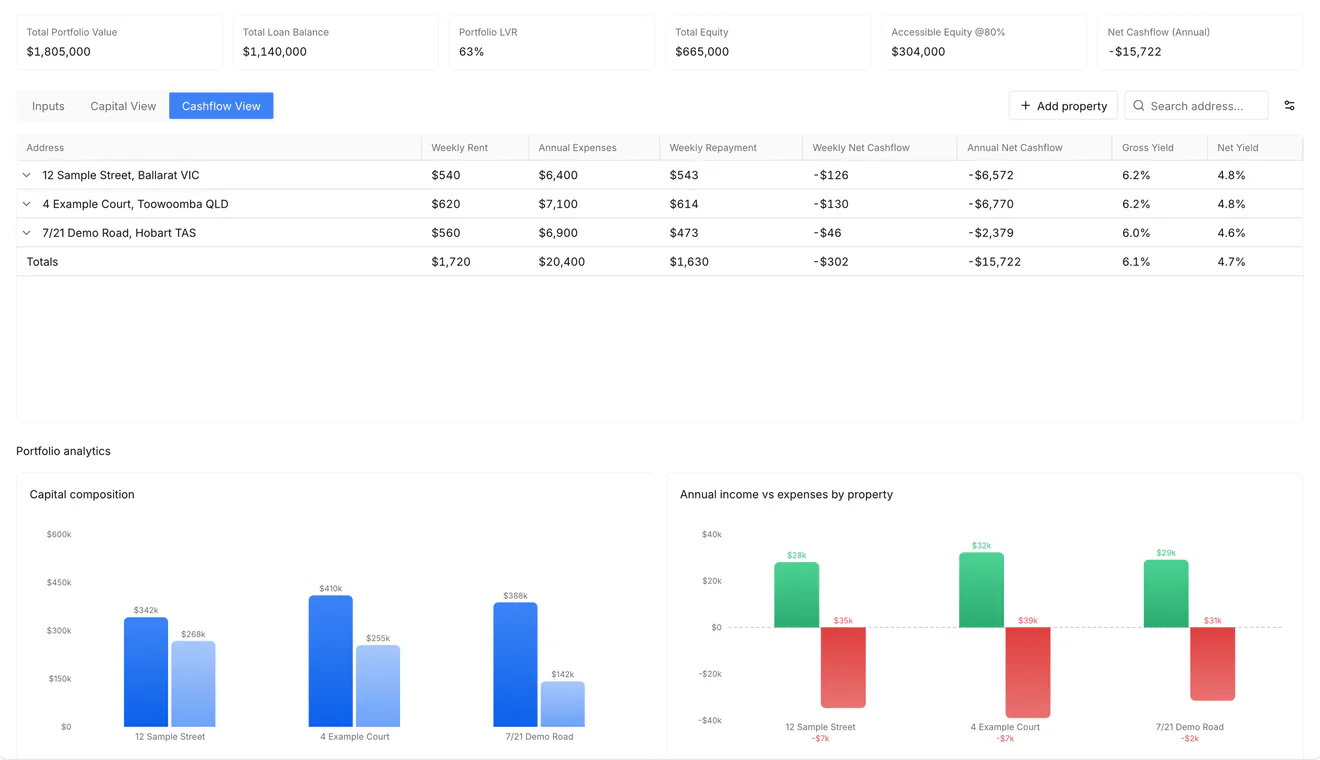
  • Portfolio. Value, loans, LVR, equity and cash flow for every property you own, in one table.
  • Holding costs. What each property costs you weekly, monthly or yearly, every cost on one card.
  • The Plan. Add the next property and see what changes, 10, 20 or 30 years ahead.
  • Calculators. Stamp duty, land tax, borrowing power, LMI and more, in one account.
Get startedNo credit card required to get started.

Want a strategist? Book a discovery call with Rising Returns

Presm Portfolio, Cashflow View: weekly rent, annual expenses, repayments, net cash flow and yields for three fictional properties
Real Presm screen. Illustrative scenario · fictional data · not financial advice

Your next property,
in perspective.

No credit card required.